|
SHOOTING
THE BLACK
POWDER REVOLVER
© John L. Fuhring
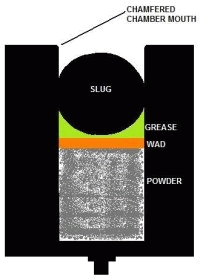 A properly loaded revolver chamber Forward
All
learning requires WORK and so I'm NOT going to shortcut the
process with "instant Internet knowledge" through videos.
There
are just some things that you have to spend time reading, thinking
about and practicing rather than rely on simply watching a video that's
over in 10 minutes.
Here
you
will encounter a series of detailed essays that you will have to spend
some time with. Yes, it is work to read all this stuff, but
it
can also be fun for the "old hands" to learn
how somebody else does things and these articles can be of interest to
the new comers who might need some background and encouragement and a
place to start. Best of all, my website is
free, without commercials or anything for sale and you don't have to
worry that your visit will be used for commercial purposes.
So,
if you have some time to do some reading and like the subject
of
black powder revolver shooting, please give my articles a
look-see.
I would like to thank Roger Nelson and my great good friend Brian, his brother, for introducing me to black powder revolver shooting in the early 1960s with his Navy Arms Colt repro. I would like to thank the men of the old 7th Michigan Cavalry for welcoming me into their ranks and allowing me and Chester the Wonder Horse to reenact with them so long ago. Thanks to the many readers who have written to me with marvelous ideas that I have tried to incorporate into the following articles. I would especially like to thank my old friend Scott Allan with whom, during our shooting sessions after work, we developed many of the shooting techniques I will shortly describe. So much time has passed, I can't remember which improved techniques were his (probably most), but at any rate, to prove them, we worked them out together. It was Scott who first took my "reenacting revolver" and astounded me with some superbly accurate shooting. I never would have believed that a black powder revolver was capable of that kind of shooting, but Scott proved me wrong. It was this demonstration and the subsequent shooting sessions with me after work that got me so interested in black powder shooting, so thanks again Scott. BEFORE YOU BEGIN, PLEASE REALIZE THAT I AM NOT RESPONSIBLE FOR YOUR SAFETY, YOU ARE THE ONLY PERSON RESPONSIBLE FOR YOUR SAFETY. PLEASE NOTE, I CAN NOT CONTROL WHETHER OR NOT YOU OBSERVE GOOD SAFETY PRACTICES OR USE GOOD, SAFE MATERIALS AND EQUIPMENT. SINCE THIS IS A FREE WEBSITE AND I DO NOT CLAIM ANY PROFESSIONAL EXPERTISE, YOU MAY NOT ASSUME THAT ANYTHING PRESENTED HERE IS GUARANTEED TO BE SAFE AND THAT I AM IN ANY WAY LIBEL FOR YOUR ACTIONS. I ACCEPT NO RESPONSIBILITY FOR ANY ACCIDENTS THROUGH MISUSE OR MISUNDERSTANDING OF THE SUGGESTIONS PRESENTED IN THESE ARTICLES OR ANY SO-CALLED "ACTS OF GOD" THAT MIGHT OCCUR WHILE SHOOTING. SAFETY, SAFETY, SAFETY, ALWAYS THINK SAFETY.
TABLE
ON CONTENTS
Compared to cartridge pistols,
black
powder revolvers require a lot more work and technical knowledge to get
them to shoot properly, they are generally large and heavy for their
caliber, they are slow to reload and you should clean them immediately
after each
shooting session. Acknowledging these
shortcomings, why have
black powder revolvers remained so popular?
Part of that answer is that legislative authorities in many countries
have put many fewer restrictions on buying and owning these weapons
compared to the restrictions on more modern weapons because it is
widely recognized that criminal elements do not use these
kinds of
weapons and that black powder shooters are generally the most
responsible
members of the shooting community. It is also recognized that
these are
relatively
safe weapons and that very few people (including owners) have ever been
accidentally killed or badly injured by them -- unlike
semi-automatic pistols -- because a live round can't be hidden inside
an action
waiting to go off and accidentally kill somebody. Now, having
said all that,
the most important reason for their continued popularity is that
shooting these pistols is
just a whole lot of pure fun -- once you get the hang of loading and
firing
and maintaining them.My essay on shooting the black powder revolver includes 8 articles. Article 1
is an introduction to black powder shooting including my personal
opinions and history
Article 2 is about modifications and techniques for preventing the embarrassment of chainfiring Article 3 is about improved loading techniques that will vastly improve your shooting experience Article 4 is about an improved, no mess way of cleaning the black powder revolver Article 5 is on simple gunsmithing you can do if you are good with tools and fixing things Article 6 contains my tips and suggestions regarding things a newcomer needs to know and own Article 7 is a special addition regarding my tips for achieving precision and accuracy Article 8 is a special addition regarding my tips for making and using paper revolver cartridges For a table of
contents that has links to all my articles, you may go to
My Revolver Article Selection Page otherwise please continue with the first article in the series Introduction to my articles on shooting the black powder revolver This is first of 8 articles The fun and challenge of black powder revolver shooting You know, I own both cartridge revolvers and semi auto pistols and I enjoy shooting (and hunting with) all my firearms, but shooting black powder is, by far, the most fun kind of shooting I do or I have ever done (now that I've worked out all the annoying kinks). When a charge is fired, there is a very satisfying amount of recoil (that you can vary from light to heavy) and there's a big jolly blast of smoke & flame. Add to all that, there's the fun and satisfaction of hitting exactly what you're aiming at. When loaded right and carefully held on target, my .44 black powder pistol is an incredibly accurate weapon that is in no way inferior to my cartridge pistols. Black powder naturally makes you want to strive to be a marksman and not just a shooter. I might add that you get a lot more "bang for the buck" because ammunition is as cheap or cheaper than doing your own cartridge reloading and one shot with a black powder pistol is as satisfying as three shots with a cartridge revolver or six with a semi auto pistol (for me anyway). Black powder shooting back in my
"Bad old Days"
Things weren't always this
good.
In the
early 1960s I used to shoot a nicely made replica of a Colt New Army
.44 Model 1860.
I remember how graceful and flowing the lines of the barrel looked to
me
and how I admired the battle scene engraved on the the cylinder.
The butt of the pistol fit my hand so nicely and working the
action just
felt good. Back then people (including yours truly) were very
ignorant of black
powder
shooting and there was a lot of misinformation circulating around
(there still is).
Multiple
discharges
(chain firing) were the norm and considered inevitable. Of
course, nobody expected the pistols to be very accurate and just
hitting the paper -- anywhere -- was a major accomplishment.
Does any of this ring a bell with you? I can hardly believe how
stupid my friends and I were back then. Our favorite loading
technique was to
pour black powder over the cylinder and into the chambers without
measuring it. When a
chamber would fill up, we'd rotate it to the next chamber without
stopping the flow. Of course, powder would get all over the
top
of the cylinder, a cylinder made sticky because of the Crisco from the
previous loading. After pouring the powder in this way, we'd
ram in the bullets. To prevent chain firing (or so we
believed),
we'd plaster (glomm)
on a thick layer of Crisco to the outside of the cylinder, little
realizing that the Crisco actually made matters worse.
Speaking
of chainfires, any shot might include a chainfire, so we'd we'd
flinch every time we'd pull the trigger. Back in those days, I remember that the Crisco made holding the smooth wooden butt of the pistol about as easy as holding on to a greased pig. I mean, the doggone pistol was so slippery that the muzzle would slide down as I'd try to hold it on target. Then there was all that nasty grease all over my hands and eventually all over my clothes as I'd forget myself and wipe them on my pants and shirt. No way did anybody want to ruin a leather holster by putting a loaded and greased pistol in it. And where did most of this Crisco come from (?), it was blown from the adjacent chambers to the outside of the pistol rather than to the inside of the pistol where it would have done some good. To make matters worse, there was the rapid build up of fouling that resulted in poor precision and accuracy (even without flinching). It was just accepted that after the first three to six shots, the bullets would be all over the target. Finally, after about 18 shots, the pistol would be jammed with fouling, the cylinder wouldn't rotate anymore and so we'd take it home to wash it out with soap and water and thus stink up the whole house with the odor of rotten eggs. I developed a mistaken
impression that
black powder revolvers were terribly inaccurate, highly prone to chain
firing, were as
slippery as a greased pig, they jammed up after just a few shots and
were a
nasty mess to clean, so after my initial fascination with them, I
finally gave up and got rid of mine. For years afterward I
shot
nothing
but cartridge pistols and used nothing but smokeless propellants in my
reloads. Years ago, if anybody would have asked me, I'd have
told
them that black powder revolvers are a lot more trouble than they are
worth. Everything changed about 15 years ago when I got into cavalry reenacting and bought good quality Civil War period reproduction firearms as part of my equipment. I wanted to learn about the Civil War by living the life of an enlisted cavalryman (in so far as I could) and one thing I was eager to know was just how effective these weapons really were and how to get the most from them. I had to relearn how things were done back then because "much that once was is lost for none now live who remember it." This gave me an opportunity to do some interesting experiments and the more I experimented, the more I learned to enjoy black powder shooting. Well, I have learned a lot since those days and now I never get a chain fire, my bullets hit the target where I intend them to time after time, the outside of my revolver isn't greasy or slippery, I can shoot round after round without the pistol fouling up and cleaning my pistol is fast, easy and odorless. For me today, black powder shooting is much more enjoyable and satisfying than it was "back in the good old days" and, as I said earlier, it is now my most fun kind of shooting. In the following articles I want to share with you some of my experiences so that you too will find black powder shooting your most fun kind of shooting. The two most popular
pistol styles then and now
By far, the most common revolvers of the Civil War era were
the Colt
models 1851 Navy & 1860 Army and the model 1858 Remington.
Both the Colt model 1860 and the Remington model 1858 styles
were and are today also available in the "Navy" (.36) caliber.
Before the beginning of the Civil War, the Colt model 1860 Army began production and was manufactured in large quantities. When the 1860 .44 Army came out, it was a sensation because the advanced steel that Colt made the cylinder out of made it as stronger than the earlier dragoon models and yet as small and light as a .36 Navy revolver. There were no U.S. government contracts for these revolvers yet, so almost all of the early production was eagerly bought by agents from those States that had or were about to succeeded from the Union and who were rapidly arming for the conflict. From those purchases, the revolvers made their way to the Confederate army and navy for future use against the United States military. By the way, the word 'Army' in that model's name does not mean that these pistols were meant for the U.S. Army, only that they were in the .44 Army caliber. Once the war began, buyers for the U.S. Government began to buy up all the revolvers Colt could manufacture and few if any Colts were left over to be sold to Confederate buyers. Nevertheless, with the revolvers purchased by Southern government agents, the revolvers bought during the Antebellum for personal use and the revolvers captured in raids and battles, the Confederacy was fairly well equipped with genuine Colt revolvers. A second in overall production was the late-to-the-market Remington model 1858. At first, government buyers bought Colts because that's all there were in any quantity. When the Remington ramped up production and became available in large quantities, the government bought all they could because the price of the Remington undercut the price of the Colts by quite a bit (nearly half the price). Trouble with contracts and high prices soon soured Colt's relations with the Government and then Samuel Colt died in 1862 and with a disastrous fire at the Colt factory in October of 1864, all Colt manufacturing ceased. Without Samuel Colt's business and manufacturing skill to give them direction, the company didn't resume manufacturing for almost two years, although they still assembled new revolvers from their inventory of parts. From the second half of the Civil War on, the numbers of Remington revolvers the government bought greatly increased even though Colt tried to play "catch up" by lowering their prices to within one dollar of the Remington's price ($12). Sales and manufacturing records show that if the Civil War had gone on for a few months longer, Remington production would have caught up to and exceeded the number of Colts that were produced during the Civil War period. Pros and cons of these two
revolver types
My favorite style of
replica
revolver
is the Remington
because of its highly superior frame design, its fixed and accurate
sight &
barrel alignment and its
ease of disassembly. Another really important reason I like
the
Remington is
because
the head of its hammer goes through a slot in the frame so that
fragments from exploded caps can't possibly get into the action and
cause a jam. All the
Colts I have ever shot have, sooner or later, seriously jammed up or
misfired because
their open frame construction allows cap fragments to lodge between the
frame and the hammer or go down into the action.
If you are lucky, all that happens is that you get a misfire,
but
most of the time the fragment goes deep within the action and really
jams it up. Once a cap fragment is deep in the action, the
Colt
style pistol almost always has to be disassembled, the fragment removed
and
then
the pistol must be reassembled
before you can resume shooting. The primitive
design of
the Colt (pretty much unchanged from the original 1836 Colt Patterson)
guarantees that
particles of exploded cap will make their way into the action sooner or
later.
It is a fact that Buffalo Bill Cody carried a Remington 1858
revolver all his life even after the era of the cartridge pistol.
He said of his Remington "it never failed me."
I
suspect he said that because earlier Colts HAD failed him when he
needed them. According to some sources, officers
who were technically savvy about weapons and who could afford it, would
buy Remingtons with their own money rather than bother with the Colts
the Government issued.There is a way to mitigate this cap jamming problem that I'd like to suggest. After taking a shot, turn the pistol as close to upside down as you can with the barrel pointed down and to the front of you, pull back on the hammer slightly and shake any cap fragments out on the ground. When you think the pistol is clear of fragments, rotate the pistol to the firing position and with the barrel pointed down and to the front of you, cock the hammer to the next round. Earlier I wrote about a technique where you keep the pistol nearly upside down while cocking to the next round, but I have found that this is a rather dangerous thing to do because of my tendency to support the pistol with my trigger finger which resulted in discharges that I didn't intend. Despite the Colt's many and glaring design defects, back in the old days, the Colt’s outsold all other brands and during the Civil War they were issued to troops on a 2 to 1 ratio to the Remington at the beginning of the War (this ratio was to reverse later in the war). There were many reasons for this. Sam Colt’s revolvers hit the market as early as the mid 1830's and the early ones, including the powerful dragoon models, made a wonderful reputation for Colt that captured the public's imagination. For decades, people used the word 'colt' to mean 'revolver' regardless of the actual brand. For example: "the colt I carried was a 1858 Remington I bought myself." Colonel Sam was also a master salesman and he made friends with every important general, admiral and government official in America. He shamelessly presented all important persons with exquisitely hand crafted, engraved & inlayed pistols as gifts. Finally, even Colt's commercial grade pistols were beautifully made by skilled craftsmen using the finest materials of the day (so-called "Silver Spring Steel" - a homogeneous, phosphorous free steel developed by Colt just before 1860 and made from Swedish ore with a carefully controlled carbon content that made it possible to build a light holster pistol in .44 Army caliber that wouldn't blow up). Colt pistols have always fit the hand superbly and they have perhaps the finest hammer location and cocking action of any single action revolver ever made. Many people also insist that Colt single action revolvers, without a top strap, have always had superior "point-ability" (important in combat shooting). For all these reasons and because the Colts had been "battle tested" in wars from India to Mexico and in countless skirmishes by the most famous fighting men of the time, old Sam Colt felt he could charge big money for his revolvers and he did. Remington was a "Johnny come lately" and had no such delusions regarding the worth of their revolver, regardless of its technical superiority. Remington's reputation would have to be built from scratch and so they were satisfied to sell a lot of "plain Jane" revolvers without fancy color hardening and cylinder engraving for much less money and by doing so, impress government buyers that way (which they did). Once in the hands of fighting men, the Remington revolver would speak for itself and at the end of the War, it was the preferred surplus revolver the returning soldier would buy and take home. Of course, there are many other types of revolvers on the market ranging from the Starr double action to the huge Dragoons to the 9 shot + shotgun LeMat to the brass framed and historically accurate reproductions of Confederate manufactured pistols in .36 caliber to Pietta's popular, but non-historic brass framed model in .44 caliber (who's brand name I will not mention). They all work the same, load the same and are equally fun to shoot, but "also ran" models are only a small fraction of what people were shooting then and just a fraction of what people are shooting today, so I am not going to go into any detail about them. Let it suffice that the general information presented here applies to them just as it does to the Colts and Remingtons. The fact is, no matter what type of revolver you have or you decide to get, it will be a lot of fun to shoot and the owners of each type comes to really like what they have. It is really hard to make a mistake here, so if you like the looks of a particular model or you like some historical aspect associated with it, buy it, you won't be sorry. What major
brand to buy and where to buy it
Both Colt and Remington styles are
available from
the major brands, so the question is, what brand should you buy?
I admit that I
am prejudiced in favor of the Uberti brand and prejudiced against the
Pietta brand. As far as I'm concerned, all the other brands
lie
somewhere in between. My Uberti is a top of
the
line model, it
shoots
very accurately and it is the most faithful reproduction of the
original
Remington on the market. I am prejudiced
against
Pietta firearms, but not because of their superb fit and finish (the
external
machining, fit & finish is indeed superb), but because of
my
early experience with them as inaccurate shooters due to what I saw as
substandard & inaccruate machining of their firing
chambers and especially their bores & rifling.
Perhaps by now
they have improved that aspect of their manufacturing and they can be
expected to shoot as well as any brand. OK, since writing the above, I've had an opportunity to do some minor but extensive gun-smithing on a friend's Pietta that he has had for several years, but had never fired before. After a bunch of work, I have it operating nearly as well as my Uberti. While working on it I noticed the internal machining was poor with a lot of tool marks in the deeper parts of the chambers and the chambers were not all exactly equal in volume. Based on this and my old prejudices, I "knew" that it wouldn't be a good shooter. Well, we went to the range to fire it for the first time and the first thing I did was show my friend how to load the pistol "properly" as I describe in chapter 3. My friend wasn't so sure it was safe, so he insisted that I take the first few shots (maybe he was afraid it would "explode" on me). Not expecting the pistol to be very accurate, I amazed my friend and myself by hitting in the black every time (and, of course, NO chain fires). After this latest experience, I think I might have to take back what I said earlier about Piettas not being accurate shooters. Obviously, Pietta has improved the quality of their barrels. Just this last Christmas (2013) the son of a friend of mine was given a Pietta Remington as a present. Of course, I had to look it over. I looked it over very, very carefully with a strong magnifying glass and I admit that I was very impressed with both the internal and external workmanship of this latest example of Pietta's manufacturing. In nearly every respect it was the equivalent of my two Uberti pistols and I have no doubt that it will be a fine shooter. I now have to admit that Pietta's quality standards have vastly improved in the last few years. I would still be somewhat cautious about buying an older Pietta (unless it is definitely a well proved good shooter), but the newer ones are excellent. In addition to advising you avoid the older Piettas, I think that the "specialty" models (ones that are not in large production like the Starr and the 1863 Pocket) should be strictly avoided too. I say that because these specialty pistols are obviously made in inferior shops with inexperienced workmen and without the emphasis on quality control and precision workmanship that Pietta now puts into their mainline .44 Brass, 1851, 1860 Colts and their 1858 Remington models. Then there is a question of where you should buy. In most places in the USA, a black powder firearm may be ordered through the mail in addition to buying one at a retail store. These firearms are also available for sale at many Civil War reenactments at the areas reserved for the "sutlers." Personally, (and they aren't paying me to say this), I think that Dixie Gun Works is an excellent bet and I've only had the most positive experiences with them including their superb gunsmithing department. I appreciate that they aren't always trying to "hook" me with "special discount offers" on stuff I don't want. I am prejudiced against Cabalas (and any other retailer) who advertise some of their products with misleading or downright false historical descriptions. For example, Pietta's .44 caliber brass framed so-called "Confederate Navy" model is a fake, a falsification of history and what they say about the originals having been made in the South and used by Southern Officers just isn't true -- and a major retailer should know better than to say so. I have no experience with Cabalas' gunsmithing department (if they have one), so I can't speak to that. OK, I just learned that Cabalas doesn't have a gunsmithing department. The other thing I don't like about Cabalas is the fact that they keep an amazingly detailed record of EVERYTHING you buy. Their powerful computers keep track of everything so that they know exactly what offers and products will "push your buttons" with deals "you can't refuse." They know what guns you have, how much and what kind of ammunition you shoot and even what kind and color your underwear is (Cabalas camo or RealTree camo). Lord knows, I really detest a kind of intrusive marketing that makes government spying look very amateurish and so I shop around and try not to let any retailer know any more about me than I have to. Of course, good for you if you aren't as uptight about this as I am. Some good deals on Piettas and some lesser known brands may be had at the Civil War reenactments, but it is unlikely you will get any follow-up service from these sellers. My advice is to buy the best from the best, but it is up to you to judge for yourself who and what the best is and for this you must do a little homework. What about stainless steel
Like brass, stainless steel is not historic,
however I have been told that the
period bluing process was very soft and many revolvers were polished up
very brightly and looked like the modern stainless steel models.
As far as I'm
concerned, stainless steel is just another finish option and is no
better than a well maintained blued steel revolver. Stainless
doesn't rust, but it can pit if neglected, so, in my opinion, all black
powder revolvers, regardless of the metal of the frame, cylinder or
barrel should be cared for in the same way.Recommended
revolver types
Ruger
Old Army.
Totally over engineered, historically
meaningless, but by far the very best black powder revolver ever
manufactured.
These superb revolvers are a true firearm classic and nothing
like them will ever be manufactured again.Post Civil War and Modern engineered black powder revolvers Pietta .44 "Confederate Navy." The brass frame and unengraved steel cylinder are both "rebated" (cut into) just as the 1860 Colt Army is. The big difference is there is no cylinder engraving and the fact that historically, no Army caliber revolver ever had a brass frame. It is seriously illogical calling a .44 Army caliber revolver a "Navy." Now, I will admit that the overall shape of the barrel does resemble the Colt 1851 Navy, but that is only a superficial resemblance. The fact is, these brass framed pistols are Army in every respect. Good shooting (for light charges), extremely popular, well liked by their owners and very affordable. This is an entry level black powder revolver that sells in huge quantities and has probably done more than anything to popularize the sport of black powder revolver shooting. I sincerely wish Pietta and everybody else would start calling these things "Pietta Brass 44's" and please stop calling them "Confederate Navys" already. They are Army not Navy caliber and nobody in the Confederacy (or anywhere else) made this kind of pistol. By the way, Colt's new fangled extra strong Silver Spring Steel, that made light weight .44 caliber pistols possible, was not available, except in limited quantities in the Northern States and in Sweden and completely unavailable to the small arms manufacturers in the South. This is another reason that the so-called "Confederate Navy .44" is a historical fake. Rogers and Spencer. This model incorporates the best design features of the Remington in addition to their own improvements, but they are historically meaningless since the originals were never issued during the Civil War (or any war). When the originals were manufactured, they were already obsolete because cartridge pistols were on the drawing boards, there were plenty of revolvers left over from the War and the U.S. Army didn't want to issue a pistol they would just have to recall in a couple of years. Because they were never issued or used by the military, many originals are in outstanding condition and may be mistaken for modern reproductions. Besides their mechanical virtues, many people like the feel of the hand grip. Sheriff's models. The short barreled Colt and Remington type revolvers are very popular and fun to shoot and I'm sure that period gunsmiths cut down a few for customers, but that's not how any of them came from the factory. In order to get a proper muzzle velocity using a low pressure propellant like black powder, the barrel must be seven inches or more. In addition, a pistol with a long "sight radius" can much more easily be held on target for long range shooting. In addition to all that, if the loading lever is likewise shortened, loading will be much more difficult (and painful) and an external loader will pretty much be a necessity. Northern States manufactured
revolvers available in reproduction
Colt Type. Any
model and caliber with a steel frame and full
length barrel is an excellent choice. For those who want a
strong and historically
accurate revolver, I do not recommend buying the modern brass framed
models. Be aware that Colt never made a single brass framed
revolver at any time or in any caliber. Even the very first
1836
Colt Paterson had a steel frame. If you are looking for a
little
.31caliber revolver, I highly recommend one of the 1849 models in
steel (such as my Baby Dragoon). Remington Type. An 1858 model in .44 or .36 caliber with a steel frame and full length barrel is a superior choice. Strictly avoid the very poor shooting 1863 .31 "Pocket Pistol" by Pietta in brass or steel. The barrel is way too short for the bullet to achieve a usable velocity, the chamber diameter is less than the bore diameter and so they are underpowered and notoriously inaccurate. These Pocket Pistols by Pietta are reported to have many other quality control problems. To the best of my knowledge, the rare early (percussion) version of the 1863 .31 pocket is the only pistol Remington ever made with a brass frame. Brass framed reproductions of the larger model 1858 may be strong enough to load full charges, but they are historically incorrect. Root Side hammer. Model 1855 with a full steel frame. This reproduction by Pietta is widely reported to have serious quality control problems and are very expensive for a little .31 caliber pocket pistol. They are really an interesting looking novelty pistol, but I don't recommend them because of their reported lack of quality and high price. Starr single or double action. I consider these interesting revolvers, but a novelty pistol since so few were issued. The double action model was unreliable and earned the pistol a bad reputation; this bad reputation is maintained by the modern reproductions by Pietta. The later single action model was much more reliable and popular. As with the Root, I don't recommend them because of their reported lack of quality and high price. Whitney Navy. A .36 Navy caliber revolver with a solid steel frame similar to a Remington. Even the grips are much like the Remington making it a barely legal copy of the Remington Navy. The original revolvers did not have a good reputation for reliability and relatively few were made. The reproduction by Palmetto is no longer in production (that I know of), but used ones are available. Confederate manufactured
revolvers available in reproduction.
Leech
and Rigdon.
A copy of the 1851 .36 Navy Colt with a steel frame.
Modern copies might be acceptable shooters.Dance and Brothers. The .36 Navy models were a copy of Colt's 1851 Navy and the .44 Army models were copies of Colt's 3rd Dragoon but most of these pistols were manufactured without Colt's recoil shields. Less than 500 were made altogether and so I consider these a novelty pistol. Although these are strong pistols with a steel frame and are historically accurate, the modern reproductions come without the recoil shields (as did most of the originals) and I consider the missing recoil shields as a serious safety issue that renders these pistols dangerous to the face and eyes in case of a chainfire. Colt's Silver Spring Steel was not available in the South and so these pistols had to have the thick and heavy chamber walls of the Dragoon pistol they copied. Of course, your pistol will be made of modern high strength steel even better than Silver Spring Steel, but still thick and heavy. Spiller and Burr. A .36 Navy caliber copy of a solid frame Whitney, but with a brass frame. Another rare novelty pistol. LeMat. I consider these novelty pistols too since so few were actually made and were probably too heavy and large to have actually been carried by the few Confederate officers they were given to. Originals were in .40 caliber so today's .44s are fakes. Griswold & Gunnison. A .36 Navy caliber copy of the 1851 Colt. The originals had a gunmetal (reddish) bronze frame. Historically significant because this model, although greatly inferior to the Colt, was the best and most popular pistol made in the Confederacy (about 3,700 manufactured). Fortunately, today's cylinders and barrels are made from modern homogeneous steel and not from twisted bars of wrought iron, as were many of the originals. The barrels and cylinders of modern copies have a smooth, deep blue finish that the wrought iron of the originals couldn't have had. Modern copies are likely to have a frame of ordinary brass so avoid full charges and strictly avoid any fakes in .44 Army caliber. I wonder how many of the originals were thrown away as soon as the officer could get his hands on a captured Colt or Remington? The reproductions are far superior to originals in terms of strength, appearance and reliability. How
much you should spend on your revolver
As it is with most things in life, the
higher
quality
you buy, the better it works and the more fun it is to own.
This
is very true when it comes to the replica pistols. The cheap
revolvers work
OK, but if you really want to shoot well and own something you are
proud of, buy something that is
slightly more than you think you can afford. "Nobody was ever
sorry
they bought
quality" is something that should be considered when hesitating to
spend
the extra money on an extra nice pistol. While I'm throwing
out
aphorisms, consider that "a thing of beauty is a joy forever" and
something beautifully made is seldom cheap. Now, having said all that, I must admit that many people would like to try the sport of black powder revolver shooting, but don't want to invest a lot of money in something they aren't sure they will enjoy. I hate to admit it, but the truth is, the Pietta .44 brass framed revolver (I just can't bring myself to call it by its oxymoronic brand name) is sold very cheaply and for what it is, it shoots very well, it is an excellent bargain and something that has done more than anything else to introduce a lot of people to the sport of black powder shooting. If you want to try this sport, but are not sure you will like it and you can't borrow somebody's revolver, go ahead and get one of these revolvers and I assure you that you will really enjoy it. A Preface to John's
Intemperate Philippic Regarding Brass Framed Revolvers
If you
have a brass framed revolver already, I hope you won't be too offended
by
what I say next. You see, I'm on a one-man crusade to stamp
them
out because they are mostly un-historical and brass is a soft and weak
metal. On the other hand, if you don't care about
historical accuracy and are happy to shoot light charges (the most fun
kind of shooting anyway), then you will really enjoy your brass-framed
pistol
and you should just ignore the following rant. (and why you might want to ignore the following rant) Another reason to ignore my rant is this: even the most ardent opponent of brass revolvers (like me) must realize that the extremely low price, the superb value for the money and the shiny attractiveness of pistols like Pietta's (lord give me strength to say it) "Confederate Navy" revolver are what attracts many people to our sport in the first place. Unpolished brass does not pit, but forms a deep and handsome patina that may be enhanced with certain commercial products and that is a plus for many people too. Regarding all this, I (reluctantly) have to admit that the brass framed revolvers not only look pretty, but they shoot well, they are rugged (if not overloaded) and are a superb bargain. In short, they are a low cost, low risk introduction to the sport and in that respect, perform an invaluable service that even old curmudgeons like me have to appreciate. John's
Intemperate Philippic Regarding Brass Framed Revolvers
(you don't have to agree with because it's just my opinion)
OK, here is my unvarnished opinion for what it is worth:
There is one
kind of black powder revolver that I
would seriously
advise staying away from and that is the brass frame Colt types.
These are beginner's pistols that can not shoot full charges
and
they are not historically accurate.
It is a fact that Colt never, ever manufactured any of their
pistols with a brass frame and no more than just a handful of
brass framed Navy .36 caliber pistols
were manufactured in the South during
the
Civil War. Furthermore, only Dance & Brothers ever manufactured
a
revolver larger than .36 caliber and no brass framed Colt type .44
pistols were ever made by anybody until Pietta started
manufacturing them. By the way, I believe
that there are some
brass frame Remington types out there too. The fact is, Remington never,
ever
made a brass frame pistol in the
Army or Navy calibers
and all my research indicates that the brass framed New Model Pocket
Pistol by Pietta is a fake, so any brass framed Remingtons you
might see
are historically
inaccurate too. Because of the strong frame design, a brass
frame
Remington type pistol might be able to stand full charges without
falling apart, but is it really worth saving just a few bucks and end
up with something phony?
You re-enactors of
either
side, do you want to "farb" yourselves this way even if the ignorant
public doesn't know the difference? You Southern re-enactors
wishing to have
"Confederate" equipment to be as "historically accurate as possible,"
just remember that the vast
majority
of arms used by the South were
weapons that were in armories before hostilities began, captured
weapons and
weapons bought from overseas - and
none of these were in brass.
It is highly unlikely (in my mind anyway) that any front line
Confederate officer or cavalryman would have carried a crude,
regionally made
brass-framed
.36 Navy Colt knock-off, but that the very few pistols that were
actually made
were
issued to Home Guard units only. To those new to cavalry re-enacting and who are just now buying their uniforms and firearms, you should know that the Confederate sections of most Civil War re-enactment associations forbid brass framed revolvers unless they are historically accurate copies of revolvers that were actually made in the South. I think that it is a well known fact that the famous John S. Mosby considered the Colt 1860 .44 Army (loaded with round balls) as the revolver of choice -- and that should tell you something. Then there is the fact that buyers in the South bought all the Colt 1860 Army revolvers Colt could manufacture directly from Colt before the beginning of the War, so if you buy a Colt reproduction, you will have a "Confederate" revolver without having to resort to a brass framed model. If you want to own a strong revolver and you want to be as "authentic" and as "period" as possible, if you want to avoid "farbing" yourself and ending up with the "wrong" kind of revolver or something forbidden to carry at a re-enactment, please stay away from brass. More important than the historical inaccuracy of brass is the issue of strength. Let's face it, brass framed Colt type pistols have a terrible reputation and over and over people warn that shooting normal charges will cause the cylinder shaft to pull out of the frame. As the shaft pulls out, the pistol gets all loose and the thing is ruined. This is especially true of the big .44 caliber models that Pietta has the shameless gall to call a "Confederate Navy" model. OK, it has come to my attention that owners of recently manufactured brass framed .44 caliber pistols claim that their Colt style revolvers show no signs of becoming loose even after firing hundreds of rounds at full loads. Not seeing how this could be possible, I've done some research into the metallurgy of copper alloys. It seems that there are alloys that are called 'brass' (but are technically bronzes) which are much stronger than common brass or even gunmetal brass (bronze). Speaking of gunmetal, the few 'brass' framed .36 caliber pistols that were manufactured in the South in the 1860s were, no doubt, made of gunmetal bronze salvaged from worn out cannons, but, modern brass framed pistols can be made of god-knows-what kind of brass, some of which is so weak as to earn these pistols their notorious reputations.I greatly suspect that some of the newer brass framed revolvers are made of manganese brass (called 'brass' but actually a bronze) and if so, they are in strength just a little below the low carbon steel used in steel framed revolvers. I would hazard to guess that a manganese brass framed revolver is probably strong enough for any kind of normal load. So, how can you tell if you have a brass framed pistol that is (almost) as strong as a steel framed pistol? Unless you have access to a metallurgical laboratory, you can't be certain, but if your frame has a pretty gold color to it, it is probably ordinary brass as the stronger bronzes have a less attractive, more reddish hue. Now, the truth is, I'm just guessing that some recently manufactured brass pistols are made with a high strength alloy, I do not know FOR A FACT that any of this is true and, for all I know, a brand-new brass framed revolver is very likely to be made of a kind of ordinary brass that is too weak to allow shooting full loads. Conclusions: If you already own a brass framed pistol, I would like to suggest that you take it out and shoot it and while you are at it, try out some of the suggestions I will be presenting. Please note that these pistols are loaded and shot exactly like any other black powder revolver and no special precautions apply to them except that most people advise against full (over 30 grain) charges. Now, if you like this kind of shooting (and I think you will), you might want to consider buying a second pistol and then use the new one as your main "Shootin' Iron.". A lot of shooters eventually buy more than one black powder pistol (I have 5), so when you go to buy your next pistol, consider a steel frame model. Once your brass pistol has served its purpose, you might want to consider polishing it up real shiny, put in in a picture frame and hang it on a wall where it will make an outstanding decoration. We all know that brass pistols are just as much fun to shoot as steel pistols, but, unless you are sure you have a frame made of manganese bronze, I suggest that limit your loads to half charges. If you insist on shooting full loads and your pistol becomes loose, use that as an excuse to buy that (steel framed) pistol you always wanted. If you shoot full loads and it doesn't get loose, great, you have a pistol made of the "good" kind of brass and you can continue to enjoy shooting full loads. See, you just can't go wrong no matter what you choose to do. For those who already have a .44 caliber revolver with a brass frame or to those who insist on buying a brass revolver because they don't want to risk a lot of money on something they aren't sure they will like or those folks who just like the looks and the outstanding "bang for the buck" that brass framed revolvers offer, let me say this: please, please, please don't follow Pietta's bad example and call your pistol a (shudder) "Confederate Navy." Please refer to your pistol as a "modern brass framed .44" and avoid the absurdly oxymoronic "Confederate Navy" name and you will demonstrate that you know the difference between Army caliber (.44) and Navy caliber (.36) and also that you know something about the materials that were used in Colt frame design. Finally there is this, if you don't already have a brass framed pistol and are still considering what kind of pistol to buy, I urge you to consider getting one with a steel frame because, for a trivial amount of additional money, you will own something that is superior in every sense. Look, for a few bucks more you can have a steel frame Colt or a Remington, so please don't bother with brass. These brass framed fakes (I will not call these things "reproductions") are flashy when they are polished up and they sure look "old time" to those who don't know much about period pistols, but they are vastly inferior to the same pistol with a steel frame. By the way, most colts have a trigger guard & mainspring frame that is made of brass and there is absolutely nothing historically inaccurate or weak about having this part made of brass. Now, when all is said and done, all these revolvers, regardless of their type, frame material and caliber are a load of fun to own and a load of fun to shoot and that point can not be overemphasized. As mentioned before, you just can't go wrong no matter what you choose. There, I feel better now. A
Foreword
to my Black Powder Articles
Speaking of dangerous, these revolvers
can be
dangerous if
mishandled and misused. They do not have many of the safety
devices of more modern revolvers and they take more
technical skill to load
than do modern metallic cartridge weapons and loading involves
handling a very flammable and explosive powder. It should
never
be
forgotten that
these weapons were primarily designed to kill other human beings and
they are just as deadly as any
modern pistol. For example, a .45 semi-automatic pistol will
throw a slug out at about 900 feet per second which is exactly the
velocity a .44 slug comes out of an "Army" revolver. A slug
fired from a .36 "Navy" pistol has external ballistics identical to a
slug fired from a modern 38 Special. Careless
or stupid handling of these
pieces (like everything else) can lead to tragedy. With proper
care in loading them and sticking to common sense shooting rules --
like
pointing them in a safe direction, wearing hearing and especially eye protection,
Etc. -- they are quite safe & fun to shoot
and surprisingly accurate. Always remember that you have a
moral
and legal duty to handle these weapons responsibly.
In the following
series of articles I would like to
share
with you some of my ideas regarding shooting
the black powder revolver. In the pages that will follow, I
will
discuss the causes and prevention of chain firing, a highly
unconventional method of loading that prevents fouling from building up
and spoiling your precision and accuracy, the fastest, easiest and best
method of
cleaning
your revolver, some simple gun smithing you might want to try for your
self and an article about all the things you will need to have
and you will need to know before you begin this hobby.
I
have just added two new sections on precision and accurate shooting
tips
that you might find useful and an article on paper revolver cartridges,
but please check out the other articles
first. Much
of what I will present goes against common practice and debunks many
long held
myths associated with black powder shooting. I invite you
to be very
skeptical
of what you read and to try things out for
yourself. One of the great pleasures of black powder shooting
is
the opportunity to experiment and try out new things. You may
not
agree with everything
presented here, so if you think something presented here is stupid or
might be dangerous for you to
try,
don't
try it.
The second article in this series will be about the simple things you can do to absolutely prevent chain firing so you never have to worry about having a chain fire again. End of page 1
Continue on to Page 2 of my
revolver
articles
or Select another revolver article or See my other shooting articles that includes three articles on flintlock shooting and even a story about my flintlock lighter If you are planning to leave without continuing, If you have any detailed comments, questions, complaints or suggestions, I would be grateful if you would please E-mail me directly Return to my Home Page |